Sunday, January 08, 2006

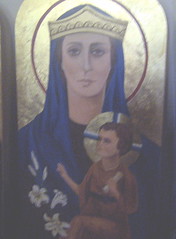
An Icon of Mary of Walsingham


An Icon of Mary of Walsingham
Originally uploaded by Chaplinesque.

After the Epiphany

I've been bad! In that I haven't written for so long. Partly that is because my routine is different over holidays, partly because the creative urge is currently occupied elsewhere with some new projects taking time, but I didn't mean to let this blog go silent for such a long time.

The last time I wrote was just before Christmas and I wrote something about waiting to be surprised. It came in the middle of the Eucharist, looking to my right and watching the people come to eat the body and blood of God as if it was an everyday right, something they were created with every right to do whenever they wanted; which is of course exactly right and wonderful to see!

It reminded me that, even though we arrange it within the architecture of holiness, there is, in the middle of the Eucharist, something wonderfully everyday: the just plain stuff of consuming the reality of God's love and presence and outpouring creativity in every moment of life, and probably much more beyond that. The reality of communion with God is both so beyond all understanding and closer than any mediation, radically here and there at the same time. Does any of this make sense?

One more time I am reminded why I am no kind of fundamentalist: I believe - and it is at the centre of my hope - that Jesus is the word of God for me, but this is no written down, codified, connect the dots and win the prize, kind of word, it is more a word spoken in particular moments, a word carried by a warm breath from the face of a loving, forgiving, challenging friend or stranger. The surprising gift of the conection with the God of the universe, opened, enligthended, pointed out in the particularity of an instant in time, in a consistency of newborn caring truth. It is not easily understood, still less easily thematised into a systematic or dogmatic theology, though these exercises can help mightily in preparing the ground for the gift of grace. But in that moment looking at the meeting place at the altar, where people came from many places to take part in, consume the deep truth of who they are and what they're about, I was reminded one more time that the world is full of gift. Thank God. Have a great new year!

Sunday, December 25, 2005

A year Old, But Whatthehell...

Saint Mary’s Anglican Church
North Melbourne

Christmas Eve 2004

Robert Whalley

Merry Christmas! Merry Christmas! Merry Christmas! Have you heard that much this year? I think I heard it first a few weeks ago, but it was October when I first saw some red and green displays showing themselves at Big W: and then there was a small mountain of red and green coca-cola six packs and I knew it was on the way. Merry Christmas. It is usual, expected this time of year, like part of the family; the greeting, the day, the feast, happens every year, and we forget how very odd it all is, how strange. The surprising child so far away, the shepherds in the field, terrified to see that what they thought was far off, was coming closer, magnified in their eyes and ears. “For to us today is born is born a savior…” Even without the foreigners coming along with gifts in a few days, it is a very foreign story.

These days we generally don’t seek a savior, though most days we do the best we can with what’s out there, and that is important. We do what we can; cobbling together an identity from need and custom, mixing memory and desire to meet the marketplace, minimizing the pains that come. We take up the daily tasks, watch the news, get along. And usually avoid the fleeting feeling that we’ve missed the train for some important event along the way, not seen the sign or taken the turn, and the billboards along side seem diverting enough while we speed on our way.

But then, sometimes, someone or something comes along from the deeper realm of birth and death, and we remember that our views and vocabulary are made up, choices that we’ve agreed to most days; to be certain ways, to see certain things. And we remember that we see only what we look for, and maybe we haven’t looked far enough or close enough lately.

So, how can we learn to see farther, how can we come to see closer? I think this child, this baby Jesus, is a kind of lens enabling us to see farther and closer. The chance of this child makes us focus, clears our sight for a moment, to look out on a world that may be much bigger then we know, may be more full of intent and information than we’ve ever supposed. The birth of this child can sometime make us wonder if the universe is both much larger and more intimate than we’ve expected. It is a surprise.

Yet there have always been hints and guesses that this might be so. From both the new science and the old poetry, wisdom speaks across tradition and time, that love might have a human face, that justice may prevail and warring factions finally lay down their weapons and find peace, that the meek will be blessed, the lost will be found. And hearing all these ancient echoes across time, we do occasionally glance around, in these busy times, to see if a new revelation might be born.

Mary takes that chance – if we listen to the story: a teen-aged woman in first-century Palestine, with her assured future along the common way, hears an angel, messenger of heaven, very foreign, proclaim that newborn truth could come from somewhere else, and become flesh of her flesh, beyond belief, virgin-born life. And she says Yes to that inconceivable possibility: and gives her future, her ascent, her life towards that new life,

Can we take that chance? When the world is so crowded with noise and news and necessity, can we take the chance that a true new love can come to us here and now, that each of us, every one of us might serve as messengers, birth-givers, seed bearers, mothering some unknown merciful truth to be born in the middle of here and now? What if that light did dawn for us tonight? What if?

Listen: we are here to sing the songs, pray the prayers, remember the story, take the broken bread and wine of the savior into our own bodies and blood, and consider this: that the creator of the whole shebang has come here into the very middle of everything, as newborn, self-giving love, as interconnected relationship which is wanting to be known, lived into, lived out. The kingdom of heaven has come among us, close as seed and breath, light, sight, soul. What can we say in response, how do we live with this?

Can we will to stay with this story? It is not easy, will mean both death and birth for us. Paradoxically, it is both painful yet full of promise: to live with the contradiction of infinity and fragility, history and hope, Can we be present to the timeless one coming into the world just in time to meet our long list of demands with a simple story of love and acceptance, and an assurance that no one and nothing will be lost at the end. Is that possibility enough for us to begin to take up that task and that discipline now?

For tonight it is Christmas Eve, when we remember his birth. And some kind of window is open; the light comes through, a connection is being made. In the midst of a tradition where much is superfluous, archaic, irrelevant, dying; there is something alive, newborn, waiting to be lived, not only in Bethlehem but here and now, in you and me. Take the chance, it says, that the Creator of all has come closer, deeper into all creation, waiting to be known, to be present, as newborn love. Can we take this up? It will take time, discipline, thought and action. But if it happened once, can it happen here? Can that creative love take form and direction, heart and breath, flesh and blood again? Can we enter into mystery and faith in this noisy age and let this hope be born again so that a new and enduring love may live in our own lives, in our own world?

There is no program for this seeing; it is only given. But in this moment, and in the moments that follow in this holy season; may we keep our eyes open, our hearts clear, our wills ready, so that we may take up our part in bringing the reality of that child we remember today to the midst of the world he waits to serve.


Merry Christmas!

Friday, December 23, 2005

Getting ready...

It is almost Christmas and I am tired, stretched out, even a little down. Partly that's been the busy season of Advent, making an end and a beginning at the same time. Partly some ongoing knee and back pain that have lowered my energy level.

So I look forward to the celebrations tomorrow night: first a Mexican dinner with the ministry team at St. Peter's Eastern Hill, then Carols and the Midnight Mass with all the smells and bells that can be mustered, and that's quite a lot at St. Peter's.

We did an Advent series for four Thursdays during the season and that was good preparation, but the best of Christmas often comes as a suprise, as Eliot writes in Choruses from the Rock, "The altar must be built in one place for the fire to descend in another" and I am ready for that fire to come and surpise me tomorrow night.

Have a blessed holiday!

Tuesday, December 20, 2005

RMIT UNIVERSITY IN THE PUB

C. S. Lewis and the Philosophy of Narnia

"In the wake of Disney’s epic movie adaptation,
discover the spiritual, mythic and ethical
implications of “The Chronicles of Narnia”
as RMIT academic John Lenarcic engages
in conversation with university chaplain
Robert Whalley. "

Wednesday January 18th 2006 at 7pm.
Free admission
The Stork Hotel,
504 Elizabeth Street, Melbourne.
Phone: 9663 6237
www.storkhotel.com

Sunday, December 18, 2005

Fourth Sunday in Advent - St. Stephen's and St. Mary's, Mount Waverly

Let’s start by setting a scene where one character meets another, meets a stranger who seems to have some deep authority and an important message. They meet in a large room and, as the curtains are drawn and the lights come up, this messenger pours forth a whole new understanding of what the world is and how we are to live in it. The messenger gives his good news:

“It is the international system of currency that determines the totality of life on this planet! That is the natural order of things today! That is the atomic, subatomic and galactic structure of things today! Am I getting through to you, Mr. Beale?

“We no longer live in a world of nations and ideologies, Mr. Beale. The world is a college of corporations, inexorably determined by the immutable by-laws of business. The world is a business, Mr. Beale!

“It has been since man crawled out of the slime, and our children, Mr. Beale, will live to see that perfect world in which there is no war and famine, oppression and brutality— one vast and ecumenical holding company, for whom all men will work to serve a common profit, in which all men will hold a share of stock, all necessities provided, all anxieties tranquilized, all boredom amused. And I have chosen you to preach this evangel, Mr. Beale”.

And Howard Beale, played by Peter Finch in the 1976 Oscar winning film, “Network”, can only look and say, “I have seen God”, and Arthur Jenson, the television network chairman played by Ned Beatty, smiles and says, “You just may be right, Mr. Beale.”

But he just may be wrong too. For that may be one, very powerful way of envisioning the world, of making sense of what to do and how to be, what matters and what lasts: but there are other ways as well, and that’s why we’re here, to enlarge our hearts and minds, and to deepen our understanding of other, even truer, ways to be in the world; maybe just as one old prayer puts it , to “keep our pity fresh and our eyes heavenward, lest we grow hard”
So, here’s a second - and again somewhat edited – scene with a few similarities to the first.
Here a young girl is met by a messenger who says this:

“You have found favor with God and you will bear a son who will be the child of the Most High, who will reign… forever, and of his kingdom there will be no end. The Holy Spirit will come upon you, and the power of the Most High will overshadow you; therefore the child to be born will be holy; he will be called Son of God’… Then Mary said, ‘Here am I, the servant of the Lord; let it be with me according to your word.’ Then the angel departed from her.”

So my question is this: how do you see this, make sense of it, how do you connect this announcement of Good News with your own life? I like movies a lot, and I think one of the best films on the life of Jesus is a low budget 1960s movie called “The Gospel According to Saint Matthew”, directed by an Italian named Paolo Passolini and made on the island of Sicily. The way he films this scene is especially wonderful. Mary is a beautiful young girl, and when she sees the angel, a gorgeous creature, her eyes light up in amazement, love, rapture.

You can see absolute joy in her eyes to receive this message, to let it come into her life. And then we follow her through the film as she follows Jesus. We see her when they nail her son to the cross and take his body to the tomb, we see her two days later when she goes with the other women to anoint his body and finds instead an angel at the door to the tomb announcing that he now lives; and it is the same angel! You can see that old joy in her eyes, it is an old face now, wrinkled by the years, but the same eyes, and the joy when she sees the same angel.

So what angels do we see? What messengers do we make room for in our sometimes so crowded lives? Most of us don’t live in the movies or in scripture for that matter, though we may find them important for our envisioning: so we don’t often get androgynous Italian youths telling us that we are blessed, will bear fruit for the healing of nations.
Nor do we hear, as Mary will hear from Simeon, that a sword will pierce our heart as well. But we do get a lot of messages about who we are and what matters, what we can take for granted and what we can give to one another,
we hear these messages on the television and the movies and the radio as well. And sometimes they are very loud. They color our understanding of who we are and what we’re about. And they make it difficult, sometimes, to listen carefully when some surprisingly good news comes to us, as it did to Mary, and is almost too good for us to believe. But it is important be awake to come to take the chance.

For I believe that in the very centre of reality, in the deep heart of holiness, there is only one angel, only one message. It may come at different times, with a different emphasis, be heard in a different voice, using different words. But it is the same, and it is this: that God has come to dwell in the midst of humanity. As the angel’s message to Mary announces God’s intention to meet with her in unspeakable intimacy, to conceive a place where God’s love might dwell in the very centre of humanity; so God’s message comes, in all times and in all places, to tell us the same truth: that God is desirous of living with us.

God has come to build a home in our hearts, to make our human being a sacred place where steadfast holy friendship may be found, announced, created, made flesh, to make a meeting place where our - and every - life may be redeemed from unmeaning and insignificance.

For we, like Mary, are called to be a place, to live a life, which consents and opens to God breathing deep into all our individual being, our limits and loves, our history and hope, our talents and tragedies. For Mary it was to take a unique part in the birth of God with us, in giving human life to the one we call Lord and God, this Jesus whose birth we celebrate in this coming season of Christmas. That is one unique task, but it is a model for our call as well. For the messenger asks us, like her, to be willing participants, birth-givers in our own way and with our own God-given disabilities and abilities, taking our part in co-creating an unspeakably intimate and unbelievably great conspiracy of Holy love.

That is the heart of the message announced by the angel to Mary, and to us today as well. God is coming near, is here, here in the middle of your life. God is willing to meet you, is with you, from before your birth to after your death, and in all the intervals from here to there. God wants to keep company with all of us, all of the time. This is the greatest truth, the Good News that comes with Jesus and which, perhaps, has been forever, but angels, I think, always begin their message with the word “Now!”

Unfortunately we usually don’t. We say, “Someday”, or “I remember” or “What if” or “If only”. We so often hide from the promise and presence of God’s word meeting human flesh in glory. We hide in the shade of the tamer paler stories and slogans that are announced on every other street corner and on every channel: so many other announcements, messengers of wisdom, calling for allegiance and conformity: “Experts agree.” “You get what you pay for.” “Early to bed early to rise.” “Better not to try than to fail.” “Only take sensible risks.” “Play the percentages.” “The world is a business.” “Don’t get hurt again.”

And the Angel comes to us and says, “Now” in every moment and waits for our response in every instant. It is a response that requires amazing audacity and an even greater humility: and it is asked of each of us right now as it was asked of Mary so many years ago. Listen, Meister Eckhart said this in a sermon some 700 years ago.

“It is more worthy of God that He be born spiritually of every pure and virgin soul, than that He be born of Mary. Hereby we should understand that humanity is, so to speak, the Son of God born from all eternity. [For] When we humble ourself, God cannot restrain His mercy; He must come down and pour His grace into the humble, and He gives Himself most of all, and all at once, to the least of all. It is essential to God to give, for His essence is His goodness and His goodness is His love… God brings forth His Son in thee.”

And the voice of the angel is heard, and the word of the angel is now. And the gift of the angel, which we see in the promise of Mary, and know most fully in the life of Jesus her son, is that we, each and everyone of us, are blessed by God and welcomed into the joyous company those who offer life and live in Christ.

May it be to each of us according to his word.

Amen
Thursday, December 08, 2005

Thomas Merton writes...

“Am I sure that the meaning of my life is the meaning God intends for it? Does God impose a meaning on my life from the outside, through event, custom, routine, law, system, impact with others in society? Or am I called to create from within, with him, with his grace, a meaning which reflects his truth and makes me his “word” spoken freely in my personal situation? My true identity lies hidden in God’s call to my freedom and my response to him. This means I must use my freedom in order to love, with full responsibility and authenticity, not merely receiving a form imposed on me by external forces, or forming my own life according to an approved social pattern, but directing my love to the personal reality of my brother, and embracing God’s will in its naked, often impenetrable mystery.”

Wednesday, December 07, 2005

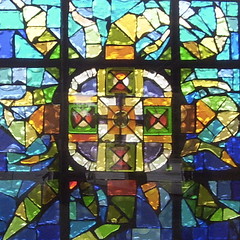
Stained Glass


Stained Glass
Originally uploaded by Chaplinesque.

One of a set of panels at La Trobe Univeristy. I pass them several times a week, and they always refresh me.

Prayers at the Carol Service, RMIT University

Thomas Merton writes that we are a variety of voices and one silence. So let us gather in that shared silence to remember our common cares and concerns in the ways which we follow and the worlds in which we live, wishing for ourselves, for one another, and for the whole world we live in nothing less than Shanti, Shalom, Salaam, Peace.

And we shall say together, Shanti, Shalom, Salaam, Peace.

Let us take time to give thanks for the various traditions and communities, individuals and institutions, rites and rituals, human gatherings over time and place that open the sacred to us in daily life. To the constellations and communities that cast our eyes and our wills godward; encouraging and enabling us to find peace, live in hope and practice the faith and passion that comes in the centre of human beings fully alive.

And we shall say together, Shanti, Shalom, Salaam, Peace.

Let us take time in one silence to remember the world and its’ constituent nations and kingdoms, the powers and principalities of the earth: All the hegemonies of economics and desire, people, animals, plants, minerals, with all our shared histories of blood and hope, of sacrifice and sacrilege, victor and victim, corruption and redemption. That all our increasing knowledge may lead to a deeper and finer compassion and wisdom enabling us to take up the holy relationship of steward and lover, that we may care for all of ourselves, the family of all sentient beings, as well as all patient plants and minerals, as partners and co-creators within this fragile ecosphere.

And we shall say together, Shanti, Shalom, Salaam, Peace.

Let us take time in one silence, to give thanks and reaffirm our care for our own communities, the places where we live and move and have our being, where we work and where we live, where we laugh, cry, bed down and rise up daily. That we may be honest and open with each other, that justice and equity, fairness and honest affection may take precedent over economics and short term gains, that we may live and work together on the common path and not merely the bottom line.

And we shall say together, Shanti, Shalom, Salaam, Peace.

Let us remain in silence and recall those that have suffered in the past year, both in silence and in tumult, for all victims: for those who touched by wars and acts of violence, by fear, famine and natural disaster. For the people of Iraq, Israel and Palestine, the horn of Africa, Southeast Asia, and the underclass of the Americas and all other rich nations, that violence and terror, corruption and injustice might cease, and peaceful understanding grow; that we might see how much we have in common, how much we have to lose, and how much to gain in sharing peace and plenty.

And we shall say together, Shanti, Shalom, Salaam, Peace.

In one silence we remember that newborn and the departed, magical children and wise and wizened elders, those who have been close to us in our work or play, for all linked to us by blood or daily occupation, who are no longer near. In this transition time, we recall all who go on journeys, who go to unseen places and unknown ends; that there may be a connection that abides and, in some unforeseeable way, a union that returns. That we may one day be one again

And we shall say together, Shanti, Shalom, Salaam, Peace.

And in the midst of silence, we regard our neighbour, whether friend or stranger, nodding acquaintance, casual opponent or mystery of being, and we wish them well in this season of birth and beginning, of mystery and ending, as a gathered community of one silence and the gift of a variety of voices.

Let us say to one another, Shanti, Shalom, Salaam, Peace.

Wednesday, November 30, 2005

A Letter Sent Today...

Dear Friends of the Chaplaincy at La Trobe and RMIT,

I am forwarding along parts of a letter I received today from Sarah Wickam, current President of the La Trobe University Student Representative Council, asking that I help to gather some voices of protest and support for forthcoming action in Canberra on legislation impacting Student Unions at Australian Universities. Sarah has advised me that of the following:

"Earlier the reports out of Canberra and the coalition party room sounded like the VSU legislation would not get into the Senate before the end of the year, and that the legislation itself when passed would not be implimented until 2007.

"However, yesterday I received several phone calls from reliable sources including Jenny Macklin's education advisors that VSU is on the move, National Senator Joyce is as solid as he will ever be. In short, he is NOT voting for VSU. So this means that the Government needs one extra vote to get the legislation through. Their only option, the man they are looking at Steven Fielding, Family First.

"It seems that he has began to back down on his stance against VSU, although saying that he will support universities charging an amenities fee (Victorian style VSU) and that he will potentially move amendments to this affect. However he remain tight-lipped on what he will do if confronted with the full legislation or nothing. The Liberals are counting on him voting for the VSU legislation."

As a US citizen who is a permanent resident in Australia, I usually avoid commenting on national politics, but having finished my first year as a Chaplain at two Melbourne institutions, I am concerned that the prevailing mood favouring privatisation and fee for service may point to a future environment in tertiary education without adequate room or support for the unique culture of Universities. As I understand it, the proposed VSU legislation will severely restrict options for ancillary services and support that are crucial to a well informed and educated citizenry. My assumption is that the changes are designed to reduce left-wing political activism, but my fear is that it will be most hurtful and harmful in withdrawing necessary support services such as childcare, centrelink, clubs and societies and advocacy work etc. and will most negatively impact returning, mature age, and non-traditional students as well as those traditional students who have benefited from their association with student unions over the years.

I would not write to you if I did not see this as similar to a trend that has undercut Universities in the US for the last few decades, where the bottom line determines the value of the educational process. I would hate to see Australia follow the US lead in this sort of gutting of civil and social organizations. If you agree that this is a critical issue and one with deep moral, ethical and spiritual components that point to the importance of the whole community working together, I invite you to please write to Senator Fielding at the address noted below. The time is limited and your response may be crucial. Please consider writing as soon as possible.

As an American resident in Australia, I have found the idea of the "Fair Go" to be a noble foundation for a people seeking to live in community in a way that is both fair and good. It is one of the things I love and admire about this country. I fear that some of the forces behind the VSU campaign may be pushing against this in a way that could be extremely hurtful to the heart of this good land. I have seen where that road can lead in other places. I hope this land will not follow that path.

Faithfully,

Robert Whalley, Chaplain,

La Trobe University
RMIT University


Steven Fielding’s contact details:

Parliament Contact:
Tel: (02) 6277 3711?
Fax: (02) 6277 5713?
Email: senator.fielding@aph.gov.au ?

Address in Canberra:
Senator S. Fielding
Leader of the Family First Party
Parliament House
Canberra ACT 2600

Electorate Office:?
PO Box 500?Box Hill VIC 3128 ?
Ph: 03 9897 3307
Fax: 03 9897 4578?
Toll Free: 1300 736 017?(Toll free number is only available Victoria)

Sunday, November 27, 2005

The First Sunday of Advent - St.Peter's Eastern Hill

I want to start with a confession, which is that I make New Years resolutions several times every year. This doesn’t necessarily have to do with the post-fifty memory loss, although I do forget my failures more easily than I used to when I was younger, and I thank God for that. But it connects more with the sense that the life I live day to day has a graceful spaciousness that increasingly encourages me to try again, begin again, as if it were the first time, like I didn’t know any better. That is one of the joys of getting older: I now feel more free to take the risk of trying something new or something old in a new way. So I make resolutions for Advent as well as New Years, and will likely continue for Lent, Eastertide and Pentecost as well.

So, as part of my pre-Advent resolution, last week I started doing a series of stretching exercises on an almost daily basis. I follow a videotape that takes me through some yoga motions and progressive relaxation stuff. It’s not very heroic, no Jane Fonda routine, but it already seems to make a difference. For one thing, I am a little sore all the time, and also a little more aware of the grace and gift of my own body, this slightly over the hill and somewhat overweight God given miracle in which I live and move and have my being. So stretching almost every day comes to be a small way to say thank you for one of the amazing and complex gifts of life.

For Life is a complex mystery and I have come to accept that and even love it most of the time. When I was younger, I must admit, I just wanted someone to give me a simple instruction manual, preferably with lots of pictures! I’ve changed on that and I now wish that someone had taken me aside instead and told me some things like, “truth can be very big and very small, and it often has more than one side”. “You’ll find that some things are very important, some things are not important at all; and you won’t always know which is which until you reach the end.” “The one thing that we are absolutely sure of is that nothing is simple to understand!”

So Life is complex and paradoxical. And the reality of God, that ultimate truth, which we know and touch and celebrate here as the creative love, the day to day neighborliness, the sweet conspiracy of God is the biggest paradox of all. The reality of God is both completely simple and clear, and – at the same time - almost impossible to get your mind around. The Good news is that you might not ever be able to understand it, but you can take it into your heart and soul and you can live it out in every part of every bit of all your life. But it is complex, and maybe especially in Advent!

Here’s a story from Joan Chittister that came from our Thursday Night Advent Study series, which, by the way, I commend to you. She writes:

The Talmud teaches that every person should wear a jacket with two pockets. In the one pocket, the rabbis say, there should be a note that reads, "I am a worm and not completely human." And in the second pocket, the rabbis say, the note must read, "For me the universe was made."

That is very similar to what the modern Buddhist teacher Shunru Suzuki used to tell people, “You are perfect as you are, and you could improve a little too!”

But I will admit these simple and complex and paradoxical truths can be small comfort when evil and terror threaten to come round with force and surprise, and peace and hope seems far away. Then it makes sense that we want to be big enough to deal with big threats, that we would seek a mighty God to marshal the forces, battle with all those malignant powers and principalities we see on the nightly news. So, like Isaiah, we might cry: “O that you would tear open the heavens and come down, so that the mountains would quake at your presence.”

That just might happen at the end of time, the Scriptures hint at it, or at some equally cinematic vindication, but we don’t get surety. What we do get instead, and what we remember and celebrate, especially in the season of Advent, is a promise of a companion on the way, en-fleshed as a child. For the Good News that comes to live with us, in the very heart of who and where we are, is an ongoing relationship seen in the midst of a human life lived in love. A life that is a light from God, that can be very small, newborn, like a precious gift, but somehow this gift enlivens us to live more deeply and love more freely, right in the midst of being small and human and living and dying. And this means that we, as we are, in the midst of our smallness and our limits and our humanity have enough and are enough.

As Paul writes, “You are not lacking in any spiritual gift as you wait for the revealing of our Lord Jesus Christ. He will also strengthen you to the end... [For] God is faithful; by him you were called into the community of his Son, Jesus Christ our Lord.”

Again, some more Joan Chittister:

“When Advent seeps into our souls, we come to understand that small is not nothing and empty is not bereft. To be small is to need, to depend on the other. Smallness bonds us to the rest of the human race and frees us from the arrogant isolation that kills both the body and the soul. To be empty is to be available inside to attend to something other than the self. We become full of the blessings of life.

“Then, emptied out by the awareness of our own smallness, we may have the heart to identify with those whose emptiness, whose poverty of spirit and paucity of life is involuntary. Then, we may be able to become full human beings ourselves, full of compassion and full of consciousness.”

So that is the hope of our faith and the shape of our journey, our liturgy and our ministry as people of God, here and everywhere, in this community of St. Peter’s Eastern Hill as well as all the communities where we live and move and have our being. All the places where we stretch out and give thanks for this great complex package of life and death and for the deep love that creates, redeems, sustains us at every step along the way.

Here’s the last hypothetical lesson I wish I learned earlier: “Learn to be still and to move well, learn to stand tall and to bow often.”

There are a lot of us here who bow and light a candle as when we enter the Lady Chapel and this is a good thing. The Blessed Virgin is certainly a primary model for our ministry, both corporately and as individuals. To quote another part of the booklet for our Advent Study:

“God's 'Yes' in Christ takes a distinctive and demanding form as it is addressed to Mary. The profound mystery of "Christ in you, the hope of glory" has a unique meaning for her. It enables her to speak the 'Amen' in which, through the Spirit's overshadowing, God's 'Yes' of new creation is inaugurated. … Mary's 'Amen' to God's 'Yes' in Christ to her is thus both unique and a model for every disciple and for the life of the Church.”

For each of us takes a part in bringing the Word made flesh into our world through the work of our daily vocations. In that we become, in some sense, Theotokos, like Mary, God-bearers, bearers of God in human form. And here is where we all might learn to stretch a bit more in our ministries in this Advent.

In a moment we will gather at the altar for a blessing on the daily occupations where each of us as lay and ordained persons serve as ministers of Christ’s presence in this good world. I hope you will come up and share your ministry and that we may pray together for all the ministries that proceed from this place.
But I ask you one other thing, that before you leave the church this morning, you walk into the Lady Chapel and look at the statue of the virgin and child there, and resolve that you will look for the places where the love, the forgiveness, the healing presence of Christ waits to be born in the world. This can be a surprising exercise, it can stretch your understanding and your ability for ministry. For Christ is coming to be born in surprising places and to live and die and rise in simple and complex ways. And if you take time to see, then it may be that not less than everyone, friend and foe, neighbor and stranger, is a place where God’s grace and glory, hope and peace, is waiting to be born.

So take your place this season, as faithful witnesses and ministers of the place where God’s unquenchable spirit meets our human flesh. Like Elizabeth, Mary, Zachariah, Joseph, Simeon and Anna, take up the ministry of honoring this child who comes to join in our own humanity, this Emmanuel, God with us, to be born in the midst of us, and give thanks for this wonderful Advent.

Monday, November 07, 2005

A thought for a Monday

Today at Morning Prayer I had a bit of a inner warming when we read the beginning of Psalm 19. It starts:

“The heavens are telling the glory of God; and the firmament proclaims his handiwork. Day to day pours forth speech, and night to night declares knowledge. There is no speech, nor are there words; their voice is not heard; yet their voice goes out through all the earth, and their words to the end of the world.”

And I thought: there’s the perfect refutation to the fundies, to the unbelievable arrogance that says words can encapsulate reality. I know a bit about poetry, and I know that good poetry points beyond itself to a truth that is beyond words. Good religion, spirituality, truth—telling, call it what you will, does th esame. It points beyond to something that is beyond belief, but something that can somehow be perceived subtly, dimly, by that open attitude some called faith.

in the 1920s a Mayor of New York City said that nobody was ruined by a book. I doubt that anyone was saved by one either. Words can be like that infamous Zen finger pointing to the moon, they can head us, open our hearts to reality. But the farther I go on the journey, the more I know that reality – and life and love and mystery and anything else worth looking at and risking for – is bigger than we can ever understand.